
Note: this is part of my objective and carefully-researched opening take on the 2024 UK General Election contest.
You know the score. Despite all evidence to the contrary, there are people too unpleasant and crazy for the Parliamentary Conservative Party, but too attention-starved to simply sit back in the membership demanding a Hitler In Every Home. Those whose skulls are little more than cauldrons filled with fermented prion soup. People who, no matter the company, are always the toddlers in the room.
These people are Reform UK. They are all utterly bereft of self-awareness, which means they’ll happily do things that scream “look at me, I’m a clueless maniac with hate in their heart and a scotch egg in their head.”
Don’t believe me?

A bold angle for a party vulnerable to a “Vote Reform UK and Get A Dick” counter-campaign.
Yeah.
Anyway, their manifesto follows this cycle’s trend of not being called a manifesto. In Reform’s case, it’s a ‘contract’. Presumably because a disproportionate percentage of them are of the Sovereign Citizen persuasion. Social contract. Get it? That’s about as clever as I think they’re likely to get. At least it wasn’t what I expected, which was something like Magna Carta 2: Feudal Boogaloo.
The short version – and the long one – is that they’ve clubbed together to Brexit Harder. That’s pretty much it, although it’s probably worth noting that they’ve shown the self-restraint to put immigration 4th on their list of priorities, despite it really being the only thing they care about with any earnestness. Equally worth noting is that, for some ineffable reason, this is point 5 on the list, because… well, look:
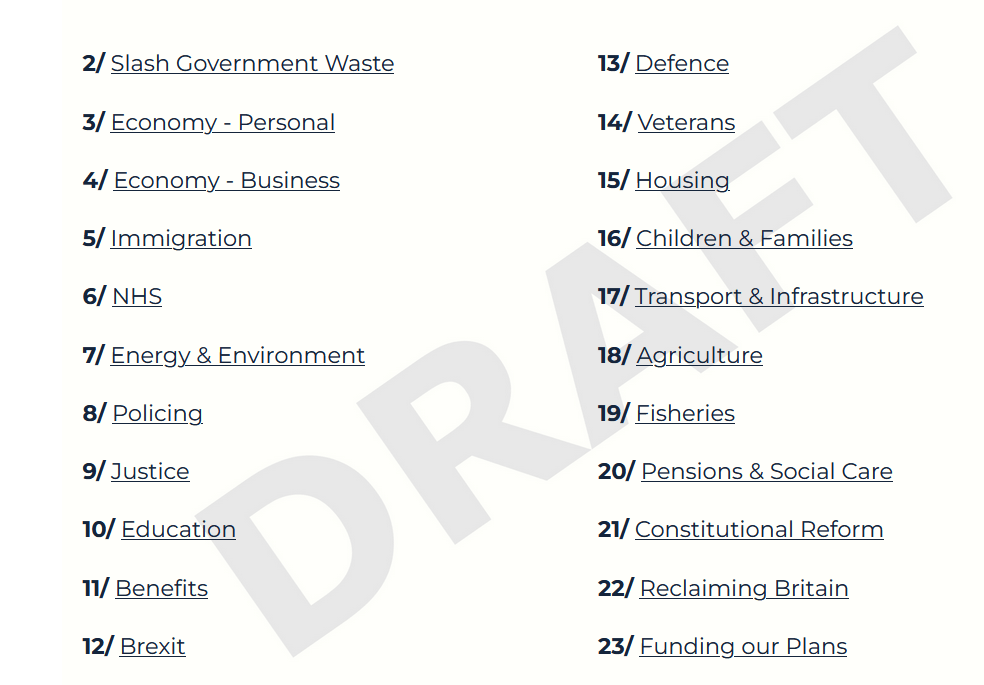
Why would you do that? Don’t they know what their first priority is? Did they forget the number 1 exists? Did somebody delete “put the foreigners in labour camps” and forget to reformat the list?
And while only one of these points is officially Brexit, a quick read shows that they’re all really also More Brexit, but in specific areas of Brexiting Harder. The 21st point (point 22) starts with “Affirm British Sovereignity.” The 18th point (point 19) starts with “Stop EU Fishers Taking UK Quotas”. And so on.
To be fair to them, they have also made room for flavour-of-the-month culture war topics like gender identity and critical race theory. And there’s a smattering of the typical incongruously sane proposals that always sneaks in to these things. But, in all honesty, the policies themselves aren’t what makes them either interesting or relevant. That’s all in what they’re going to do to marginals.
Blue-on-Blue
Much like UKIP before them, they’re a major threat to fringes of the Labour and Tory vote. But putting it like this paints a somewhat misleading picture, so I’m now going to over-explain it.
Reform have taken a substantial percentage of the Labour vote, spread over the last 18 months or so. However, that damage is already done and the trend stabilised a while ago, then recently started reversing a little. This suggests the vast majority of the Labour vote that would move to Reform have already done so and some are perhaps moving back. Yet, despite this, Labour are still polling well above 40%.
Which is a problem for the Tories, for (at least) two reasons.
First, it makes persuadable Tory voters the next obvious target for Reform. It isn’t like they’ll be winning over Lib Dem or Green voters, and they’ve already done what they can to the Labour base. However, there is no shortage of disenchanted Conservative-leaning voters, which means Reform could potentially ruin a few otherwise-winnable seats that the Tories can’t afford to lose. The Tories seem to know this, with a flurry of policy announcements that can only be targeting core Reform votes: bring back National Service and add another lock to pensions.
Second, those voters went from Labour to Reform and, looking at the polls, they didn’t get there via a brief dalliance with the Conservatives. This means they’re very unlikely to go en masse to the Tories, no matter how hard they try to win them over. The situation this creates is effectively asymmetric osmosis; Reform could leech off some Tory votes, but the Tories will find it very hard to do the same in return.

A key Tory/Reform UK battleground seat.
Don’t get me wrong – the loss of that much of the vote to Reform is bad for Labour. To suggest otherwise would be pure spin. It means they have a smaller attack surface for their campaign, in terms of making fewer Tory seats truly competitive. But that damage has already been done and Labour are still 15-25 points ahead in the polls, depending who you listen to.
As those votes are already lost to Reform, Labour need worry less about them being lost to the Conservatives, which would be a far bigger problem for them. An 8% swing towards Reform is simply closing the gap between Labour and Conservative candidates by 8%, whereas the same swing to the Conservatives would be a devastating 16% swing in the votes that really matter.
Finally, at the end of it all, Reform are very unlikely to win many – or possibly any – seats. 11% of the vote spread out over the entire country doesn’t translate to winning 11% of the seats; it translates to coming 2nd-4th in 100% of the seats. This is what happened to UKIP and, for the record, no matter how much I hate these arbitrarily spiteful crackpots, I consider that to be a major failing of our democracy.
In summary, Reform UK consists of the part of the electorate who were very disappointed that the 2016 referendum got them what they wanted, because it turns out they really just enjoyed being angry about it. To try and maintain that high, they’re gradually drifting towards a policy of physically lifting the UK out of the ocean and dropping it directly on Brussels, mooning all the way down. They pose a significant risk of costing the Tories a lot, without winning enough themselves to be able to offer any kind of post-election agreement that would return the Bastards In Blue to government.
 Inaccurate Conception
2 thoughts on “2024 Election Preview – Reform UK”