Things Can’t Only Get Better

Several times over the past few days, I’ve tried to sit down and write something, convinced the Tory campaign has hit its lowest point. I’d think to myself “right, that really is the worst it can get”, only to be drenched again by the firehose of gibberish that has been coming out of Conservative Campaign HQ (CCHQ).

It’s a ceaseless torrent of new and inventive ways of making things worse for themselves, proving that maybe the barrel has no bottom. Just keep scraping hard enough and there is literally no limit to how dreadful a campaign you can run.

You wouldn’t be blamed for not knowing what’s going on, much less why. I certainly don’t. But I’m going to try and make sense of it, none the less.

To this end – thank god – things have calmed down slightly over the weekend. Not ‘stopped’, and most certainly not because they’ve got a grip on things. Unless those things are heavily lubricated, primed grenades. Either way, it has slowed to a point where I feel like I can summarise events since the first leaders’ debate.

Which is as good a place as any to start. Or bad a place. Perspective depending.

Nobody Likes a Liar

The debate itself was exceptionally uninteresting; an hour of two men being asked questions they weren’t allowed to answer. The moderation style was of what I believe is known as the “explosive dysentery” school; a doomed bid to hold back an inevitable torrent of biblical foulness that only makes the resultant mess bigger and more embarrassing.

Starmer was, being generous, underwhelming. Sunak was more disciplined and stayed on message. Unfortunately for the government, that message was to repeat a verifiable lie over and over again, with all the charisma and credibility of a bag of privately educated slugs. With leprosy.

As someone infinitely blessed with the station of parenthood, I felt myself biting back one of my stock Dad Retorts. That is:

“What you did was bad, but would have been forgivable. You’d have got a bollocking, but that’d have been it. But then you chose to lie about it and now I have to come down like the fist of an angry god.

Sunak claimed the Institute for Fiscal Studies had provided independent figures that showed Labour’s plans – which, in the same breath, he claimed don’t exist – would mean raising everyone’s taxes by £2,000 a year. Delivered with the kind of huge, shit-eating grin that says he believes his audience too dumb to catch him out.

Somewhere above the atmosphere, divine digits clenched themselves and started hurtling toward Earth. The debate ended and immediate snap polls suggested Sunak had come out on top. Reportedly, the Tory spin room went bananas.

He’d done it. Despite all expectations, he’d landed the talking point and the public had bought it. Fawning texts were sent by his detractors. There’d be no fallout because Starmer had failed to successfully rebut the claim. The campaign was back on track.

The next morning, a letter from no less than the director of the IFS was published, calling out Sunak for his dishonesty. The letter was prior to the debate, as they’d foreseen exactly these kinds of shenanigans. The figures they had provided hadn’t shown anything of the sort. They weren’t based on known Labour policies. They wanted nothing to do with the claim.

Then the BBC sent a notification to seven million people alerting them to this information. Considerably more people saw this than had watched the debate. It filled the news cycle.

Farage Inc.

In an attempt to cheer up the much-harried buffoon currently running the country, Our Nige decided to pick the following day to make a big announcement. An Emergency Election Announcement, no less. In news that probably ruined every pair of underwear in CCHQ, Nargle Fargle gleefully announced he was taking over leadership of Reform UK and standing as a candidate in Clacton.

This was something that Tory campaign insiders had been referring to in (mostly) private as the worst case scenario, an “extinction event”, and all sorts of other celebratory monikers. Within 72 hours, polls were suggesting REFUK closing the gap between them and the Conservatives to just two points. Well within Margin of Error.

The government was now not only fighting a Labour landslide and well-coordinated Lib Dem seat-sniping, but also a flanking maneuver from the right. I fucking hate Nigel, but if I ever met him, I’d buy him two pints. One to thank him for giving me this moment of undiluted political joy, the other to throw in his face as I called him a piss-bloated shitetoad.

We’ll Leave Them on the Beaches

Meanwhile, Tory ministers – both notable and not – spent the next couple of days either distancing themselves from Sunak’s statements or doubling down on them. Which one being dictated by how desperate they each are for a peerage, I assume. They had to do this because Sunak himself was headed off to France for the 80th anniversary of D-Day.

This was a fantastic opportunity to look statesmanlike, with photo opportunities with the likes of Joe Biden and Volodymyr Zelenskyy. It’d be a chance to key into a the British sense of pride in – and reverence for – our part in such a pivotal, historic event. It would help hammer home the (possibly sole) Tory policy success, which is our steadfast support for Ukraine. Something the country largely agrees has been entirely good.

Not only that, but having banged on about National Service even when the audience laughed at him, it offered Sunak a chance to spend time with the few surviving veterans. “Look what a sense of national pride can achieve!” it would say. He could stand alongside the king, who attended against medical advice and in significant pain from his ongoing cancer treatment. Wavering REFUK voters could be swayed back to the Tory fold. Labour would look Weak On Defense. I could believe a less useless campaign might have timed the election entirely because of the opportunity this offered.

At least, that’s what a more feeble mind might conclude. Not Rishi Sunak, though. He saw a far greater prize and by god he was going to seize it. Instead of hanging around for all that guff, he buggered off early, so he could fly back to the UK and pre-record an interview for the following week. The purpose of the interview? To wriggle out of being caught lying about Labour tax rises during the debate. A level of genius only further enhanced by the fact it’d bog Starmer down having to do all those photo opportunities with world leaders. See how he liked looking all statesmanlike and patriotic.

The media went psychotic, as did the general public. If there is one thing everyone in the UK seems to broadly agree on, it’s that you don’t disrespect those who gave their lives fighting against the Nazis. People may disagree on how to best show your respect, but they’re pretty much unanimous in agreeing that being disrespectful isn’t acceptable.

The fallout from the lies turned into fallout from skipping out early from the D-Day ceremonies. It started to snowball, with Penny Mordaunt even going as far as to say it was unacceptable while taking part in the second televised debate.

Which is why, for the past two days, Sunak has gone to ground. He’s refusing any media access, keeping as low a profile as possible, presumably in the hopes things would improve before Monday. Or maybe CCHQ have decided that a campaign without the Prime Minister is a better prospect than one with him. I mean… bloody hell. Imagine being so shit at your job that it is better served going undone. You’d be fired. Right?

Narrator: Things Didn’t Improve Before Monday

The problem with disappearing from the public eye during an election campaign is you’re unable to do anything to improve your situation. When said situation is 20% behind in the polls, expecting to lose even more ground to a new threat from an unexpected direction, and peeking out from behind the bedroom curtain to check for signs of flaming torches and/or pitchforks, that’s a really big problem. When many of your so-called allies are self-serving opportunists whose loyalty to you is matched only by their skill at facing the media, it’s a really, really big problem.

Saturday was quiet. About the worst it got was the new candidate for Gove’s old seat pretending he was moving to the constituency. Following Dear Leader, he tried to lie his way out of it, only for the Lib Dems to spoil it by pointing out the property was an AirBnB and he’d listed himself on his candidate nomination papers as resident somewhere else.

With only moderately dire news like this to go with, the media started to focus on something else: rumours that Sunak may stand down or be given the boot before polling day. These are… questionable. Not definitely false, as there are some credible sources reporting it. But they definitely seem a bit nebulous at the moment. However, this is exactly the sort of damaging story that will fill the void when someone as important as the Prime Minister vanishes from his own election campaign for two days.
Sunday was mostly filled with more of this speculation, but looked like it might pass without any major fuck-ups. Mel Stride did exactly as well as anyone familiar with Mel Stride – other than Mel Stride himself – would expect when asked, on the morning media rounds, whether the Prime Minister was going to quit halfway through his own election campaign. No. Absolutely not. Never. That’d be mad.

So… maybe?

Somehow, news of this lull in gaffes made its way through the protective slime that fills Richard Holden’s rejuvenation chamber. With a gelatinous schlooorp-thwuck, he pulled himself free and declared to the world “NOT. ON. MY. WATCH.” Wiped down and zipped into a fresh Human Suit, he headed to the nearest press pool for an interview.

It… well, look. As someone who likes to sometimes pretend to themselves that they’re a writer, it pains me to admit this, but there is no combination of words I can arrange appropriately to convey how much of a fucking train-wreck this interview was. I’ll give it a go, out of a sense of duty, but it won’t get close:

It was like the morning after the leavers’ ball at circus school, when everyone is still over the limit and tries to leave the car park at the same time, causing a huge pileup of tiny cars haplessly plowing into one another. Sad squirts of water from novelty flowers try in vain to put out the flames as the air fills with terrified honking, gigantic polyester trousers burning like a forest fire in the feywild.

That’s the best I’ve got. And it doesn’t come close. Just watch it.

That’s the chairman of the Conservative Party, dear reader. The man nominally in charge of the election campaign. Someone who fled their at-risk seat for a (until this morning) safe seat that immediately tried to deselect him on the basis he’d been parachuted in as the sole candidate up for nomination.

Elsewhere, in a futile attempt to stand out against this backdrop of weaponised fecklessness, Esther McVey managed to get the entire room to laugh at her:

(Sorry for breaking my own rule and linking to a tweet, but it’s currently the only source I can find.)

This is the current state of the Conservative campaign. Just… what the fuck? It simultaneously defies belief, whilst at the same time explaining a lot about the last few years. Can it get better? I don’t know. Can it get worse? I don’t know that, either. But I suspect someone at CCHQ, hearing me type that, has just uttered the words “hold my beer.”

I have doubtless missed something important in all that. Probably several things. It has been an epochal mega-eruption of political madness; a pyroclastic flow of unforced errors, the imbecilic lava spurting through the skies screaming in inarticulate panic, and steaming gouts of sulphur dioxlied rising in grim plumes from the growing cracks around CCHQ.

Given this unprecedented display of primal devastation, it’s easy to see why, to the simple minds of the Conservative Party, it might look like the End Times.
On the 12th Day of Shitfest

The opening leg of the campaigns has been fairly unequal, in terms of content and pace. There are clearly some very different strategies at play here, each of which will doubtless shift gears in the weeks to come. Election campaigns are like a dance, in that sense, moving around each other as they ebb and flow.

If you’re thinking waltz or tango, guess again.

So, what’s what on day 12?

Conservatives

The Tories, taking bold action, went on what a charm offensive looks like if you’ve got NPD and untreated tertiary syphilis. They started strong, with National Service, which polled exactly how you’d expect it to. That is to say, deeply unpopular with anyone young enough to either have or be planning to have children, but warmly welcomed by the older demographics. Especially the weird subgroup of Boomers that didn’t fight in the war or do national service themselves, but have somehow convinced themselves otherwise.

Then there was the extra lock for pensions, which didn’t help mitigate the “fuck anyone under 50” vibe. Based on just these two announcements, I’m assuming they’re keeping the repeal of stamp duty and bringing back hanging for nearer polling day, for maximum impact.

These are, obviously, stupid policies. If the election weren’t already lost, I doubt they’d dare so much as mention them. They certainly aren’t to be implemented. Although, from a party that seems loathe to pass any legislation whatsoever if it can possibly help it, maybe that’s a given.

What’s more interesting, to my mind, is the stuff they’ve spoken about since. The stuff which is clearly intended to be a bit more down to Earth. To deliver this important message, they got Michael Gove – who had just announced his retirement – to Do A TikToks that felt a lot like something by Larry David.

In it, he outlined three key policies:

  1. People caught fly-tipping will get points on their driving license, in addition to a fine.
  2. It’ll be easier for landlords to evict tenants accused of persistent anti-social behaviour.
  3. Private firms contracted to repair pavements will be fined if they don’t do a good job.

That mess and noise and those shitty pavements, right? And people say the Conservative Party are out of touch? Bah! What’s more relatable than mess and noise and shitty pavements? Next policy prediction: the quality of in-flight meals.

Unfortunately, there’s a few awkward questions that immediately come to mind, in response to these highly innovative pieces of revolutionary policy. These are:

  1. How did these problems become so rife over the past decade?
  2. Why are the prisons and probation services so overwhelmed these crimes can’t be dealt with properly?
  3. Where will these now homeless hooligans and scrubs all go?
  4. What sort of hopelessly corrupt, disinterested cretins have been paying private firms millions of pounds to do a bad job and then doing nothing about it?

Suffice to say, these are not questions the Tories really want answered. I can’t help but wonder why, then, they prompted anyone to ask them.

Labour

Would it even be an election if Labour didn’t break out in a bad case of spontaneous tankies? I’d argue not. Thankfully, this time round, most people don’t care.

That hasn’t stopped the national press trying to make them care, mind, so we’ve been treated to a whole week of headlines about whether Diane Abbott has been forced out and whether Faiza Shaheen’s constant need for attention can ever be sated. Laura Kuenssberg has been in a state of high agitation, naturally, running her own solo Conservative election campaign with inversely proportionate amounts of gusto and integrity.

To be fair, the internal conflict isn’t a great look and was somewhat avoidable, so a demerit to the Starmer campaign office on that. But it really isn’t a big deal and I doubt the majority of people will even register what is, essentially, the cosmic microwave background of Labour bickering. Abbott is 70, so hardly had a long future with the party anyway, even if she hadn’t spent the last however long suspended.

Anyway; the hard left of the party – notably, the SCG – have had a rough run of things and Starmer seems keen to ensure that streak remains unbroken. If the remains of the Corbyn clique want to line up and finish themselves off in the name of Ideological Purity, nobody in the grown-up wing of the party is going to stop them.

This is partly because the centrists faction have only recently wrestled the party away from the hard left, but mostly because an election campaign requires a high degree of discipline. The left of the party are pathologically incapable of that, regularly putting their personal crusades and/or screaming victim complexes before any sense of unity or – apparently – desire to actually win an election. The Abbott affair seems to have blown over for everyone but the click-hungry press, but I imagine Shaheen will keep flogging tickets to the Me Me Me Circus for as long as the Grift Gods allow it. She can be safely ignored.

This leaves only one other real piece of news from the past week, on the Labour side: the Great British Energy project. This is an underrated plan to launch a nationalised clean energy company, presumably fronted by Mel & Sue. The goal is to stabilise our energy security, introduce greater price competition in the energy market, and actually do something to stop us cooking ourselves to death.

Unfortunately, due to being underrated, it probably won’t move the polls much. I’m assuming they picked it first because 1) it is quite hard to criticise and 2) they’re saving the stuff that’ll garner more attention for nearer election day.

Lib Dems

Simply amazing. Not the policies themselves which, as I’ve said elsewhere, are all Pretty Fine, but sweet baby Jesus the campaign. It turns out that Ed Davey – or, at least, his campaign team – possess bona fide marketing genius. While the Tories have been busy trying to scare everyone about Labour, and Labour have been busy trying to scare everyone about Labour, the Liberal Democrats have managed to bring levity, humility, and actual engagement to the table.

Do people care what they have to say on river pollution? No at all. But they do care about seeing Ed Davey careen at high speed down a hill whilst riding a bike. Do you they want to know what Sir Ed has to say about children’s mental health? No, because the very fact it needs saying means most of the country don’t care about children’s mental health (yes, I know). But they 100% do want to see him hurtling down an inflatable water slide.

What the Lib Dems have recognised, I think, is twofold.

First, as you’d expect, there’s a ton of noise from all the parties at the moment. If you want to cut through that to get people’s attention, you need to make them want to give you their attention. It’s a basic marketing principle and I think the Davey campaign is doing an excellent job of leveraging it. People will listen to your boring policies if you’re saying them while you do something insane.

Second, the Liberal Democrats absolutely stuffed themselves in 2019. They took themselves far too seriously, thinking they could turn anti-Brexit sentiment into a parliamentary majority. It was never, ever going to happen and it smacked of a rather off-putting lack of self-awareness. This year, what we’re seeing is far more of a “look, we know we won’t be in government, but this stuff is important and we want you to know there’s a party that supports it” message. And I think that’s good.

But, yes, it is plausible they’ll try to milk this too much and end up looking not serious. I hope that doesn’t happen, but it could. Down that road lays things like Count Binface becoming their candidate for Mayor of London, which fall into the category of things I’d love to see for all the wrong reasons.

More likely, though, is they’ll perform slightly better than predicted in polls and pick up a tidy clutch of additional seats. And, if that happens, I’ll be happy to have seen it as an outcome for a so-far wholly up-beat, positive campaign, because I’d forgotten those could happen.

The Rest

There’s not really been much from the others.

Reform are likely waiting until nearer polling day to announce their policy – Still Being Mad At Europe – because that’s what Uncle Nige dictates. I also assume they’ll try and fend of Tory attempts to woo their base via the usual awfulness one-upmanship that is the lingua franca of the far right, but so far they’ve done roughly nothing. It might be tempting to hope it stays that way, but I’d urge you to resist; that way, disappointment lies.

The Greens are aiming for the biggest ever loss of candidate deposits. They’re standing in nearly every single constituency, despite the fact they’ve got slim-at-best prospects of ending up with more than one seat. As their vote is therefore very localised, this means the polls suggest extremely low Green vote counts in all the others. Ergo, loss of deposits. I’ve seen figures around £250,000 of losses doing the rounds, which feels about right. Not sure how I’d feel if I were a party donor, but then I don’t really understand the Green Party mindset in general.

Probably the biggest news from the And The Rest category is the SNP. In the last few days, it has come to light that they left £450 million of EU funds unspent for so long that they’ve now expired and must be returned to Brussels. Regardless of where you sit on the political spectrum – but especially if you’re part of the pro-independence movement – this is a fucking disgrace. It makes the party look like it has been so busy hot-boxing its own farts for the past six years that it hasn’t been doing the parts of its job that actually benefit the people who vote for it.

If this doesn’t get reflected at the polling booth, I’ll be amazed.

And, Now, The Polls

Oh lord. We’ve had a few. Here’s the highlights, but the headline view is this: Labour landslide, no sudden blue wave, I’ve booked the 5th off work in anticipation of how hard I’m going to be celebrating.

This is very gratifying for two reasons. One, I want to see the complete obliteration of the Tory Party down to the atomic level, preferably further. Two, I’ve been saying for a while that I think the narrowing of the polls has already largely taken place.

I won’t cover all of them, but here’s a few of the bigger ones.

YouGov did suggest a bit of a narrowing very early on (only the first two days), but they’ve been one of the outliers in terms of how huge a Labour lead they’ve been showing. Even then, the changes are within the Margin of Error (MoE – get used to seeing it) so are probably best understood as “no change.”

Then there was a big one – 12,000 people – from Redfield & Wilton. This covered the middle of the week and showed Labour’s lead growing, albeit still within MoE. But definitely no meaningful narrowing in response to the Tory blitz of Big and Brilliant Policies (For Ages 65+).

Then there was one which I find hard to interpret as anything other than a desperate bit of propaganda by the Tory-owned JL Partners. Thankfully, it was quickly picked apart once they released their assumptions – anyone who said “don’t know” really meant “Conservative” – meaning any interruption to the Rivers of Salt at CCHQ was brief at best. I’m not linking to it, because the only sources are Xitter and the podcast they’re trying to promote, neither of which I want to drive traffic towards. In summary: it showed a 3% narrowing in favour of the Conservatives.

Finally, there was the double-whammy of polls over this weekend.

Friday was the Electoral Calculus / FindOutNow poll – deliciously, commissioned by the Daily Mail. This was devastating for the Conservatives, predicting them winning a paltry 66 seats. That’s 410 fewer than it predicts for Labour. This was an MRP poll covering most of last week, so high quality and indicative of how people have reacted to the campaigns so far.

The following day, Opinium dropped their own updated poll. This covered up until Friday (31st), so is the most up-to-date snapshot we have. It was teased by one of Opinium’s analysts with a tweet saying “Jesus wept”, which presumably means they think he was a Tory. They’re another pollster who has been giving a far smaller lead to Labour, which only makes the 4% swing in their favour all the more incredible.

There are 32 days left until polls close. At this rate, there may not be a Conservative Party left on day 33.

Here’s how you can help that happen.

2024 Election Preview – Labour

Note: this is part of my objective and carefully-researched opening take on the 2024 UK General Election contest.

Labour have been through the grinder since their last time in power. While the Conservatives have removed the mask and revealed the unbending malevolence at their heart, Labour have been locked in an internal battle over what their identity even is. It has been quite the ride.

On the surface, where they started seems to have many parallels with where the Conservatives now find themselves. They were at the tail end of more than a decade in power, unpopular, reeling from a global crisis, under the shadow of a war in Europe, and led by someone who really wasn’t the right person to steer the ship through such turbulent waters.

But the similarities stop there.

Throughout their time in power, New Labour had two prime ministers, the second of which stepped down as soon as he lost an election. The Conservatives have now had five, over a similar span. Only three of those have actually won an election. Two of those that did had to go to other parties for support, unable to form a government on their own majority.

In that time, Labour have been through just three leaders, each fighting for the heart of the party from different directions. This hasn’t always been great, if I’m honest; the Corbyn years became increasingly painful, massively exacerbated by his total failure to mount a strong (or even flimsy) anti-Brexit argument. But it has certainly been thorough. And now, after 14 years out of power, Starmer seems to have finally found something that can work.

But what is it?

The Plan Mission

It’d be a lie to pretend that Labour have done a stellar job of making their position clear. There’s a number of politically savvy reasons as to why they might have wanted to avoid doing that, but it has also left them open to valid criticism about who they actually are.

In part, I think that’s because they were still trying to work it out, trapped between COVID and an unknown-but-imminent general election. Starmer took the leadership at the start of a global pandemic, which threw everything up in the air. He spent the first few years planning an unfortunately necessary purge of some unsavory tankies and whackos, who’d co-opted the party under Corbyn.

This wasn’t only necessary so the party could actually move forward into an election with some degree of unity, but also pretty much all he could spend that time doing. You can’t well plan a detailed policy statement when you’ve got no idea what things are going to look like when the smoke clears.

However, that was then. Over the last year or so, the smoke has cleared and it has become increasingly clear that Labour does have a vision for its time in power. The details are still a bit thin, but its five “national missions” are remarkably similar to the platform put forward nearly 30 years ago by a certain T. Blair. Yes; the new Labour platform is, in fact, the New Labour platform.

And that’s good. It’s generally agreed by anyone who doesn’t froth at the eyes and say things like “What this country needs is <insane statement of nostalgia for the blitz>” that the first few years following the New Labour landslide in 1997 were enormously successful. It’s the kind of record that any party would love to be in a position to emulate.

They were also responding to similar conditions as we now face. We’d had nearly 20 years of Tory rule, a bloody gigantic recession, eastern Europe was engulfed in war, and the country was a mess. If it worked then, why wouldn’t you take that model, tweak it, and apply it again? Not only has it been tried and tested, but it fits perfectly within an evocative and compelling narrative: once again, after a long time with the Conservatives shitting in everyone’s kettles, Labour have a plan to get things back on track.

I think this is a large part of why the Conservatives are so desperate to paint Labour as having no plan. It’s because they know it isn’t true. And they know they themselves have no plan. They’ve become wholly reactive, possibly due to an obsession with constant – and terrible – polling figures, and the party being so divided they can’t reliably pass legislation without a massive public hoo-ha.

The phrase “Tory psychodrama” was used a lot during the post-Brexit clown convention but, truthfully, the entire last 10 years has been under a government trapped in exactly that. Whatever plans may have at some point existed have all been inward-facing, little more than self-indulgent navel-gazing by warring factions whose only properly shared value is a sense of entitlement as The Natural Party of Government.

The Challenges

The reason there is some credibility in claiming that Labour don’t have a plan sits around two main points; brute facts that dictate what is possible, and That Which Must Not Be Named.

On the first point, it’s quite simple: there are some immovable constraints on what is possible in the current climate. Economic plans that don’t at least reference reality are easily pulled apart. Said reality is frantically signalling that the economy is buggered, has been buggered for a long time, and needs carefully unbuggering before anyone does anything drastic.

What this means in practice is sweeping economic reform is off the table for at least the short-term and probably the mid-term too. Undoing the damage of the last attempt at sweeping economic reform – thanks, Liz – in itself is going to take some time. Labour’s message about stability and growth is definitely the right one, as we must stop reeling from fuck-up to fuck-up like some abstract monetary drunk. It’s bad for people, it’s bad for businesses, and it’s bad for government budget-setting.

There’s an offshoot to this, too. Sunak benefits from anything that paints Labour as not really different, because it’ll demotivate the Labour vote. If Labour had been loudly announcing good policies for the past 12 months, the Tories would simply have stolen them and then claimed everyone might as well stick with the devil they know. It’s not like they don’t have form on this: just look at energy industry windfall taxes, which went from “never ever” to “obviously we’ve always thought these were a great idea” the moment it became politically expedient.

The second point is much trickier. The Tories would be paralysed by a days-long collective orgasm if Labour dared question whether maybe Brexit or the way we handled Brexit weren’t great. After they’d recovered and wiped themselves down with unused PPE, they’d turn this into yet another election of They’re Trying To Take Brexit From You and stand a very good chance of winning on that point alone.

This is a big problem for prospective Labour flagship policies, because they don’t want to float anything that leads down the line of questioning that starts with “how would you fund this?” and ends at “so you’d join the European Economic Area?” Yet, in practice, sorting out some of the damage caused by the Conservatives’ bibs-and-blankies vandalism is a very viable way to improve the economy. Just not one they dare mention until after the polls close.

The Office for Budget Responsibility’s latest figures suggest we’ve knocked 15% off our import and export numbers because of Brexit. Not just that we did it, but how we did it. As of December 2023, annual EU-based exports were worth ~£357bn and imports ~£465bn. Improving these figures by 15% would mean adding billions to the public finances, which could be used for anything from investing in further economic stimulus or improving services such as the NHS and our schools.

But they can’t talk about that at the moment. Don’t be surprised if that changes after election day, though.

    What Next?

    Well, assuming the polls aren’t so far off that everyone gives up on polling entirely, Labour will form the next government. They’ll probably want to grab hold of a few key issues early, to be seen to be taking BOLD ACTION. I’d be very surprised if this didn’t include a bill addressing immigration in a way that isn’t “we took a bunch of acid and listened to Oswald Mosley speeches on loop for 7 hours”, as well as something on public sector investment and workers rights. Think “more funding for teachers and nurses” and something cracking down on most abusive elements of the gig economy.

    For longer term projects, I’d be surprised if there wasn’t something on anti-social behaviour measures, probably linked to reform of the judicial/probation system, and nationalisation of a few failing industries. This last would include creation of the British Green Energy business, which is a genuinely excellent proposal but that will take time to actually do anything.

    There’ll probably be a pretty major push on housing, but I wouldn’t be surprised if this isn’t immediate. It’d be a very strong area to talk about, hold lots of consultations on, and then actually launch in the second half of their first term. Doing this would put them in really good shape for another win, so while I’d love to see something really big on this on day one, I expect we’ll have to wait a bit.

    If they can get the public coffers in a healthier state, tinkering with the welfare and tax systems seem like low-hanging fruit. To get there, they may well have to address the Brexit issue in the form of a more grown-up relationship with the EU. Defense spending will rise and Trident won’t go anywhere. Joining with an EU collective defense program might be the wedge to get us back into the common market and/or customs union; Ukraine is a big problem and this ties defense spending to improving our standing with the EU. Plus, if Trump wins in November, being a member of NATO will have just become practically worthless.

    I think the core message here is this:

    Labour will focus on providing some much-needed consistency, with a focus on actually passing a meaningful legislative agenda based on a forward-looking fiscal policy that recognises the constraints of economic reality. Depending on how large a majority they can win – and so-called “macro factors,” such as the global economic and security landscape – this could result in a very productive few years, delivering real change. Not on the scale people will be hoping for, but in the direction that’s needed and in a way that is sustainable. The moment they’re in office, all eyes will be on how they can ensure they’re not a one-term government.

    Even if, like me, you don’t love Labour, I think there’s good reason to expect them to make some swift and significant improvements. Not just because it’d be almost impossible to not be better than the current shit-shower-on-a-windy-day we’ve been living under for the past 14 years, either. Even if you’re cynical enough to think they’ll not do the right thing out of principle, they’ll need to do it anyway, as before we know it, it’ll be 2029 and the Tories will be forming a coalition with the United Kingdom Reform And Pogrom party (UKRAP).

    2024 Election Preview – Conservatives

    Note: this is part of my objective and carefully-researched opening take on the 2024 UK General Election contest.

    We’re a few days past Rishi Sunak’s election announcement and the Tory campaign is already going very badly. Hopefully, that’s how it will continue.

    But it does give me a problem: there is so much to say about their time in power and now I’m faced with a veritable banquet of unforced errors, whole platters filled with abject foolishness threatening to topple over and crush me before I can fill my plate. And that’s just the first few days of the campaign. So, apologies in advance for how long this will probably end up being.

    Where to start, then? Maybe the slogan, which serves as basically every form of punctuation on their website:

    More on this later. Consider it scene-setting. A self-indulgence that will become clear. A staggeringly bland message from a party with nearly 15 years in government to come up with something better.

    But, quickly, just one aside: which fucking genius decided to put “CLEAR PLAN” in Labour red, when the main line of attack is that Labour have no plan?

    Let’s start at the end and work backwards. That seems to be what they are doing, after all.

    The Campaign

    It’s a clusterfuck. I really could end it there and you’d know everything strictly necessary to understand the state of play. But doing so would miss out on a lot of fun details.

    Never in my wildest dreams did I think they’d manage to make such an unholy mess of launching their campaign. And so quickly, too. It isn’t so much that the wheels immediately came off, as it was Sunak shuffled out of Number 10 in a box with “kar” written on the side in crayon. Then it rained and the cardboard went all droopy.

    Nearly the entire country wants an election and has done for some time. Perhaps realising the only exceptions to this were his own MPs, Sunak decided it best not to tell them, lest they oust him and install somebody competent. They don’t have anybody competent, but that wouldn’t stop those involved in the process from trying: the membership quite literally don’t give a shit and the MPs are in full-blown panic mode.

    Maybe they’d bring back Liz Truss. Boris might suddenly stop hanging around the B&M Bargains car park and hastily waffle his way to Downing Street. Gove could show up to cabinet one morning, wearing Sunak’s boneless carcass as a skin suit. So, best hang his MPs out to dry like his favourite suit before they can act. That’s the only rationale I can come up with.

    Out he wandered, then, taking up the famous lectern from which all such announcements are delivered. Once there, he promptly got utterly drenched while the New Labour anthem Things Can Only Get Better blasted out in the background. Phenomenal. And entirely avoidable.

    Showing how seriously he was taking it, he immediately hit the campaign trail. All the classics: the ExCel centre where Sky political correspondent Darren McCaffery was physically removed, the shipyard where the Titanic was built, and a pub to insult the locals about how bad the Welsh football team is. He took some tough questions from Tory Councillors dressed as Ordinary Working People (they were in hi-vis jackets) and then didn’t have breakfast with some veterans at a Wetherspoons.

    Smashing it. Clearly concerned that the pace of things might take a hit over the bank holiday weekend, it was decided to launch a key new component of the Conservative Planifesto: bringing back National Service.

    Now, I know this whole thing isn’t exactly written with the straightest of faces, but Poe’s Law dictates I need to clarify something here, because that sounds like me being snarky. “A-ho-ho, what would be a funny way to convey how out of touch and insane the Tories are? I know, I’ll pretend one of their first campaign promises is to bring back National Service! Chortle snort guffaw, I’m really very funny.”

    To be clear: I am not joking. That isn’t a clumsy attempt at satire. It’s real. They have it on their website.

    They aren’t committing to this being paid work, either. You’ll just have to do it, although you won’t go to prison if you refuse. Instead, you’ll have to pay a fine, so anyone worth hundreds of millions of pounds can just buy their kids out of the scheme and not worry about it. Or move to California.

    For everyone else, it’ll be mandatory work for the state, with little or no renumeration. The payoff is it will build national pride and equip young people for life in the workplace, while helping the Tories claim they’ve hit their pledge to increase defense spending.

    Great stuff. And what it says to me is the Conservatives aren’t fighting this election against Labour; they’re fighting it against Reform UK. Who the hell else is going to be won over by post-war, stiff-upper-lip, the kids are all snowflakes bollocks? Certainly not young people or the parents of young people. AKA much of the electorate.

    The other central pillar of the campaign is that Labour don’t have A Plan. Aside from the fact that the election has only just been called and nobody has released a final manifesto yet, it’s rank hypocrisy. The Tories have been in power for well over a decade and have got through three prime ministers in the last 2 years.

    They spent a full third of their time in power arguing over 1) whether we should be in the EU and, then 2) how not in the EU we should be. Because they didn’t plan on us actually leaving, then when we did they had no plan for how to leave or what leaving should look like.

    So no, don’t buy into any of this crazy bullshit: the Tories don’t have a plan, haven’t had a plan for years, and are still dealing with the fallout from when their last plan – the referendum – blew up in their faces. They have lurched from crisis to crisis, often entirely of their own creation, very obviously not having anything like a plan. The whole party is the living manifestation of being planless; a hive of waffling drones with no-one to serve but themselves.

    Meanwhile, Starmer has unified the Labour Party by kicking out the tankies and then built – and maintained – an absolutely enormous lead in the polls. Is he a fount of charisma? No. Has he done a good job of clearly communicating what a Labour government will do? Not yet. Is a lot of that lead because the Tories are so widely loathed? Oh yes! But he has taken his party on a journey that is the photo negative of what has been going on within the Conservative Party for years.

    The results of this haphazard realpolitik is spelled out in letters a hundred feet high, by the reaction of what are usually the stalwarts of a Tory campaign: the conservative press. The Telegraph, Mail, and bloody Spectator have all published articles endorsing Labour. This is unheard of. The Spectator article was written by no less than Nick Boles, an ex-Tory cabinet minister who left the party over the Brexit Wars. They’re not amplifying the Tory talking points, and this speaks volumes. It isn’t because they don’t believe them – that has never stopped them trumpeting Tory campaigns before – but because they don’t want to back such an obvious, stinking turd. The fact that turd is a lie is neither really here nor there.

    Get used to the words “ex-Tory minister”, too. A lot of them are standing down, including party heavyweights like Michael Gove. Of those who aren’t standing down, plenty will lose their seats. Jacob Rees-Mogg is forecast to lose his, for example, and I cannot convey how happy that will make me. Which brings us to the final comment of note regarding the campaign: candidates.

    Four days after the election was announced, the Conservatives don’t have candidates selected in nearly two hundred constituencies. Some of those, they’d lose no matter what. But not all. Some are de facto marginals. Others should be fairly safe, but only in a world where you’ve got an established candidate who has been carefully vetted and had the chance to spend some face time with the voters.

    This is not what has happened. With anyone of sane mind not wanting to waste several weeks fighting an election they know they’ll lose, good candidates are very thin on the ground. And without the time to properly vet them, I would be flabbergasted if we don’t see multiple cases of Racist Uncle Syndrome between now and election day. Completely unsuitable fruitcakes from local councils or – nnnnghhhghhggghhh – the party membership who’ll quickly turn out to have Facebook accounts following pages like I’m Not Racist But and Not Beating Your Kids Makes Them Bent.

    And, in a prediction which I sense will be as accurate as it is emotionally traumatic, a staggering amount of very questionable pornography is going to be found. Because nothing says “out of touch and angry about it” more than a hard-drive filled with borderline (or actually) illegal filth.

    It’s just one more unforced error in an already long line of them. One that any competent party, containing any degree of forethought or planning, would have deftly avoided. Something that the party calling the election is uniquely placed to ensure only happens to the opposition.

    The Past 14 Years

    It’s been shit, hasn’t it? It didn’t start brilliantly, as the global economy had collapsed and the Cameron-Osborne government took the opportunity to push ideologically-driven spending cuts. You’re All In It Together. This occupied the full first five years of their time in power, back when Theresa May was a bête noir of the left, rather than one of the few relatively reality-adjacent Tory moderates, which she became after the party went completely fucking insane.

    Governing in a coalition meant they couldn’t fully free themselves to enact all of their “free market, wink wink” dreams. The only way to deal with that was to win back the increasingly demented right of the party. Those being swayed by UKIP. Thus: referendum. The plan – the last time they had one, and it was bad – was the government would win handily, shut down the eurosceptics, and be able to get on with governing with a proper majority.

    That didn’t happen. Instead, the nutters won and, with very few exceptions, Brexit has completely dominated our political world for the eight years since. Rather than unite the Conservative Party as the broad church it believed itself to be, it tore it apart. Very publicly, over an extended period of time. Without the capacity to pass any other meaningful legislative agenda. The only tangible legislative ‘victory’ the Tories have achieved since 2010 is something one half of the population didn’t want and the other half of the population didn’t understand. Because not understanding it was a prerequisite for wanting it.

    It would take many, many, many more words to fully document what happened during those times. The spectacle of the debates over Brexit bills. The MPs crossing the floor or quitting in disgust. The three line whips being defied by cabinet ministers. Boris. Covid. Parties. Lies. Lettuce. Spiraling immigration figures.

    The experience has been utterly exhausting. Mad. Unrelenting irrationality, beyond parody, too much to even attempt to document in one place. And all to the detriment of the British people, surprisingly few of whom had the nous to simply phone up a Tory MP and offer to flog them some non-existent PPE at 700% markup. What an unenterprising lot we are.

    What did we get? A government only interested in tearing itself apart, a shit economy, and exactly the kind of unsustainably high immigration Brexit was supposed to prevent. Far higher than before. Which is precisely what many of us Project Fear killjoys had been saying would happen. In 14 years, they’ve not managed anything else of note. What else is there they can claim – the pandemic response? Everyone had one. Ours was definitely not the worst, but it also definitely wasn’t the best. And even if it were the best, it isn’t a legislative agenda win.

    But that’s all really just background to the main point I want to make about The Plan: there isn’t one. There is no reality where the Conservative Party’s conduct over their time in government – and the past few years in particular – could have been in accordance with a plan. It is wholly indicative of people who’re not capable of ever forming anything cogent enough to be described, even loosely, as a plan. What the Tories have is to plans what involuntary rectal spasms are to knitting; painful, shitty, and out of their control. And nothing to do with knitting.

    Not just for the country, either. They don’t have any functioning plans for themselves. They had to fire one of their own prime ministers after less than two months, then intervene and break the leadership selection rules they wrote in order to prevent their own membership from electing another wild-eyed maniac to replace her. Because her ‘plan’ was so very bad that merely announcing it tanked the economy.

    They need to go. Frankly, it doesn’t matter whether Labour have a plan or not. They clearly do, as poor a job as they’ve made of conveying it, but even if they didn’t, it wouldn’t change anything. The Conservatives need to go. If they can’t have the decency to self-destruct on the way out, at the very least they need to spend a long time out in the political wilderness, while they reflect on how and why they got there. Having a plan doesn’t change things if it’s designed to serve only the power-crazed, morally bankrupt, systemically useless lunatics who wrote it.

    Unless they evolve into something entirely unrecognisable from their current form, they are not fit for government. They shouldn’t be running the country, plan or not. Not only is it reasonable to believe Labour will do a better job than them, or that you or I could do a better job than them. Although that, too. But it is also reasonable to believe that if this blatant and remorseless abuse of power goes unpunished, it will only get worse. If we don’t vote them out – by any means necessary – they will get worse. Much worse.

    So go they must. Whether you like Labour or the Lib Dems – whoever is the best tactical vote in your area – doesn’t matter. People need to go out and say enough is enough, there’s a limit to what we’ll tolerate, so please:

    It really can’t happen soon enough.

    2024 Election Preview – Everyone Else

    Note: this is part of my objective and carefully-researched opening take on the 2024 UK General Election contest.

    As always, there’s a clutter of parties who’ll be hoping to make gains, but who have no hope of really shaping overall outcomes. Some of these, I’ll get out of the way immediately: the various factions in Northern Ireland and Plaid Cymru.

    These are regional parties contesting too few seats to ever be a major factor, each with very limited individual support. This election is a contest between two ideas: the Tories are awful and must be removed no matter what, versus Labour will summon an Eldritch God with whom they’ll make an open-borders pact and the country will be flooded with immigrant Shoggoths. There is no room for a repeat of the DUP shakedown of 2017. In fact, even with the paucity of seats at play in these regions, it looks very unlikely there’ll be much in the way of movement from the current electoral map.

    But there are two parties that fall into the Everyone Else category that it’s worth giving a bit more time: the Greens and the Scottish National Party.

    The Green Party

    The Greens have a PR problem. Some of this is ideological, some of it is not.

    First off, those which are not are largely self-inflicted. There are a few to choose from, but I don’t think any is clearer than one I can easily show you: their policy position. Or, rather, how they’ve chosen to present it. See that massive sidebar on the left of the screen, with all the links? Click on one. At random. I did. I picked “Economy.”

    Done it? Good. Now, did you just think “well, I’m not reading all that“? Me too. And I’m a politics nerd. What we’re seeing here is symptomatic of precisely half the problem the Greens have created for themselves; nobody who isn’t really eager to understand their policies will ever bother to read them. Those who are really eager to understand their policies are probably already invested enough that they’re voting Green anyway. They probably helped write them, even. Someone must have.

    It’s a spectacular failure at Communications 101. I’m all for nuanced and well-considered policy positions, backed by evidence and framed by compelling arguments. But to win an election, you need to provide an accessible BBC Bitesize version that people can easily absorb.

    This problem extends to the public face of the party. Did you know they have two party leaders? Many people don’t. Can you name either of them? I certainly couldn’t without looking it up, and I love politics. They’re Carla Denyer and Adrian Ramsay. For what it’s worth, Denyer looks as surprised by this as anyone.

    And, like much of what the Greens do, that isn’t a bad setup. Different, but with potential upsides. It’s just a huge issue that most people don’t know that is the setup, much less who either of the people in question are. It’s a problem with messaging, which you really don’t want when your entire purpose is to get people to buy into your message.

    But this is only half of their problem. The flip side is, they’ve grown up around a few activist factions with single-issue bugbears that are enormously unpopular with the majority of the electorate and, frequently, reality itself. It’s these that tend to get the headlines, because they’re easy to articulate and evoke a clear response. No nuclear power is probably the flagship of this armada of ideas that are neither popular nor sensible.

    I won’t go into the rest in detail here (because I really am not reading all that), but the point is this: they’re a very long way from making a meaningful impact on British politics. They strike me as not so much a serious political party as a kind of alumni association for people who really miss being on Student Union action committees. But then maybe I’m doing them a disservice and all I need to do is read their 40-billion word Philosophical Basis.

    Yet, despite all that, the Greens have more than doubled their predicted vote share – from 2.8% to somewhere north of 6%. Depending on how thinly spread that is, they could do anything from lose their one existing seat, to increase that count to 4. In the latter scenario, where they do that might have a small impact on major party totals, but mostly it’ll be a bit of a litmus test as to whether the appetite for shaking up the status quo is growing as much on the progressive side of things as it is on the far right.

    Based on the polls – and the fact they’re not gaining votes because of a super-slick comms team – I’d say it looks like this may be the case. But how well they do nationally will confirm or deny that theory.

    The Scottish National Party

    Of substantially more importance than the Green, the SNP are – on paper – major players in a substantial number of seats. They currently hold 48 out of the 59 Scottish Westminster constituencies.

    However, the party has recently undergone what we’ll charitably position as an ‘air-to-ground reshuffle’. Humza Yousaf terminated the SNP’s pact with the Scottish Greens, causing the Scottish government to fall apart, with him losing a confidence vote and promptly resigning.

    This means the new leader, John Swinney, has only been in position for three weeks. The only headline of note that this has garnered is that he hasn’t bothered to fill the party function of Minister for Independence. It is very hard to interpret this as anything other than giving up on the idea of another referendum in the foreseeable future.

    If we’re being honest, they’re probably pretty done-for, as Nicola Sturgeon was the very successful glue that held them together. Now she has gone and her replacement has turned out to be a hapless buffoon, and his replacement has just been released from the Party Leadership Womb, I suspect they’re going to suffer.

    Sturgeon carried them through the (failed) independence vote of 2014, rode the wave of anti-Brexit outrage, and had the force of personality to act like a Westminster power-player without actually being one. Without her – and their raison d’etre of endless independence votes – I think what we’re seeing is more than just bad polls; I think they’re going to try and reinvent themselves as a broader political mission, then fall apart.

    Whatever the truth, the relevant facts are that:

    1. Their polling was pretty bad even before the latest mess.
    2. Having a brand new leader installed 2 months before election day is far from ideal.
    3. They’ve functionally abandoned their core defining policy goal.

    It’d make sense that things are likely to get worse before they get better, as now there’s an opportunity for people to voice their disgust in the form of the ballot box.

    Which – like many other things mentioned in these posts – is bad news for the Tories. Nobody likes them in England and even fewer people like them in Scotland. But so long as those people who’d never vote Tory were instead voting SNP, it wasn’t that much of an issue. If they now – as is likely – end up voting Labour, that in itself is a substantial haul of extra Westminster seats that the Tories can’t win, nor can be hived off by Reform.

    This might be a longer-term issue for the Conservatives, as if the SNP have in fact ditched their commitment to Scottish independence, they don’t really stand for anything that another party can’t also stand for. That translates pretty directly into “there’s no reason to vote SNP instead of Labour anymore” and the upcoming election will show us how many people have realised that. My bet? A lot.

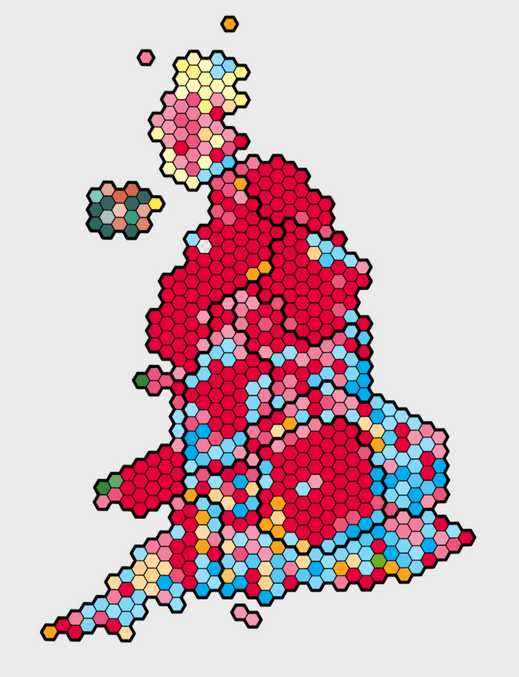
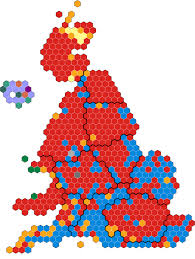
    If that happens, we get a map that looks a lot like this:

    And if this looks familiar, that’s because it’s the 1997 results map. There are some very slight changes (e.g. there are 650 constituencies now, rather than 630), but it’s near enough.

    So, the SNP aren’t playing a part in the way that the Lib Dems and Reform will, by taking votes. They aren’t acting as a kind of yardstick for drift from the major parties, like the Greens will. They’re simply going to tell us whether Labour can start relying on Scottish seats again, which is doubtless something Starmer’s team will be keen to understand. Not least because it helps them gauge their odds of winning a second term in another 5 years, which in turn helps set policy direction and scope.

    Just before I leave off here, you may note that I haven’t linked to the SNP policy platform. That’s because it isn’t really relevant to this election; most of the country can’t vote for them and they’ve traditionally been a one-issue party, but have now seemingly dropped that one issue. You can read their positions here if it interests you – just be aware that there is effectively nothing in there that will influence the big picture.

    2024 Election Preview – Liberal Democrats

    Note: this is part of my objective and carefully-researched opening take on the 2024 UK General Election contest.

    Ah, the Lib Dems. What should be my natural political home, were it not for an aura of fumbling indifference and lingering resentment that surrounds everything they do. They’re the political equivalent of walking into a quite pleasant, tastefully decorated room in which someone recently left a particularly acrid fart. The culprit isn’t there to actually blame anymore, and the room itself is pretty decent, fart aside, but they’ve managed to taint it enough that you feel like maybe it’d be best to come back later.

    I think we all know who the fart is, in that metaphor.

    Anyway: “the Lib Dems are running a really interesting campaign this year” is something I one day hope to be able to say. As things stand, they’re not. Instead, they’re running the most boring, by-the-numbers campaign imaginable. They seem to have one policy – fairness – which they’ve then put other words around and sorted into a numbered list.

    One of the Not-A-Manifesto-Manifestos club, they have called this their ‘plan’, which I’ve put in a side note about below. But the important thing is that they do have a plan. And it is fair.

    A Quick Word on Plans

    This election, we are in a quantum superposition of planning. Everybody both does and does not have a plan. For instance, the Tories who don’t have a plan are pretending they do, while saying that Labour don’t have a plan when they clearly do. It’s Coalition of Chaos, Redux. So, bollocks, basically.

    So, what is this fair plan? Well, it’s fairly plan-y: a list of perfectly reasonable, inoffensive ideas outlining their plan, all of which are worded in such a way as to feature the word ‘fair’. The kind of stuff that, were most people aware it existed, would prompt comments like “that seems sensible.” But most people won’t see it, because the last time the Lib Dems dabbled in fanfare, Jo Swinson had to order herself out into the carpark and have herself shot.

    What I’m getting at is, in terms of electoral strategy and policy platform, they’re playing it safe. So safe that the only really remarkable thing about it is how unremarkable the whole thing is.

    To be clear, I don’t mean to suggest that’s the wrong thing to do; I think it’s exactly what they should be doing. It seems they’re aware that they really need to learn to walk before they can run, this time round. Ed Davy looks to be focused on guiding them to a long-term recovery, rather than some phoenix from the ashes fantasy. Sure, they’re still littering my hallway with “Only the Lib Dems can win here!” gibberish, but it seems like they’ve learned from past mistakes. They understand they’re not quite back in from the cold yet, and remember what happened the last time they pretended they could really honestly for reals form a government.

    Why It Matters

    Nobody is expecting miracles from the Lib Dems, this year. The election is really a straight dust-up between the Labour and Conservative parties, with the former widely predicted to utterly batter the latter. What’s going to shape that, though, is what happens with Reform UK and the Liberal Democrats, both nationally (Reform) and in key seats (Lib Dems).

    First off, I expect we’re going to see a higher than average amount of tactical voting this year. That’s maaaybe part of a wider multi-cycle trend, but mostly down to the fact this election is really about how much everyone is currently sick to death of the Tories. Negative voting will decide this election and there’s only one party that’ll form the hand from which that democratic middle finger is extended: Labour. I don’t say that out of partisanship; I’m no flag-flying Labour supporter; it’s just something the data very clearly shows could happen.

    What the Lib Dems bring to the table is helping shape the severity of the battering that’s handed out.

    They might pick up a point or two of stray Tory vote, probably from the types of people who tend to vote no matter what, have an entrenched antipathy towards anyone with a red rosette, but have found the centre of the Tory party is now somewhere in a yurt with Genghis Khan. This makes the races in a handful of marginal seats even tighter. Combined with Reform doing the same from the (far) right, this could help Labour take an even bigger majority of seats across the country.

    Second and probably more importantly, the Lib Dems have demonstrated a knack for running successful campaigns in target constituencies. It’s a skill that’s almost the exact inverse of their inability to mount a coherent national campaign. As such, I’d be very surprised if they don’t pick up a modest handful of new seats because, unlike Reform, their vote share is typically quite concentrated.

    This is something of which they’ll be especially mindful this year, as there is a – pretty remote – possibility that the Tories get take such a glorious drubbing that they don’t even carry enough seats to form the opposition. To be clear: this is very unlikely, but notable because it’s the first time it has been even that.

    That sounds mad, even to me, an ex-member of the party. You’d be forgiven for thinking I’m just spouting fantastical Swinsonite nonsense. But a quick look at the seat prediction spread on the excellent Electoral Calculus shows I’ve not gone completely doolally just yet. It’s an outlier, granted, but not such a distant one as can be safely ignored.

    I’m not sure I can imagine what a parliament with the Liberal Democrats as official opposition to a huge Labour majority looks like, but I’m sure a lot of people at Lib Dem HQ are doing just that. What I can tell you, though, is it would be very, very funny. I’m in a Lib Dem marginal, since the boundary changes, so it looks like that’s where my vote is going.

    2024 Election Preview – Reform UK

    Note: this is part of my objective and carefully-researched opening take on the 2024 UK General Election contest.

    You know the score. Despite all evidence to the contrary, there are people too unpleasant and crazy for the Parliamentary Conservative Party, but too attention-starved to simply sit back in the membership demanding a Hitler In Every Home. Those whose skulls are little more than cauldrons filled with fermented prion soup. People who, no matter the company, are always the toddlers in the room.

    These people are Reform UK. They are all utterly bereft of self-awareness, which means they’ll happily do things that scream “look at me, I’m a clueless maniac with hate in their heart and a scotch egg in their head.”

    Don’t believe me?

    Yeah.

    Anyway, their manifesto follows this cycle’s trend of not being called a manifesto. In Reform’s case, it’s a ‘contract’. Presumably because a disproportionate percentage of them are of the Sovereign Citizen persuasion. Social contract. Get it? That’s about as clever as I think they’re likely to get. At least it wasn’t what I expected, which was something like Magna Carta 2: Feudal Boogaloo.

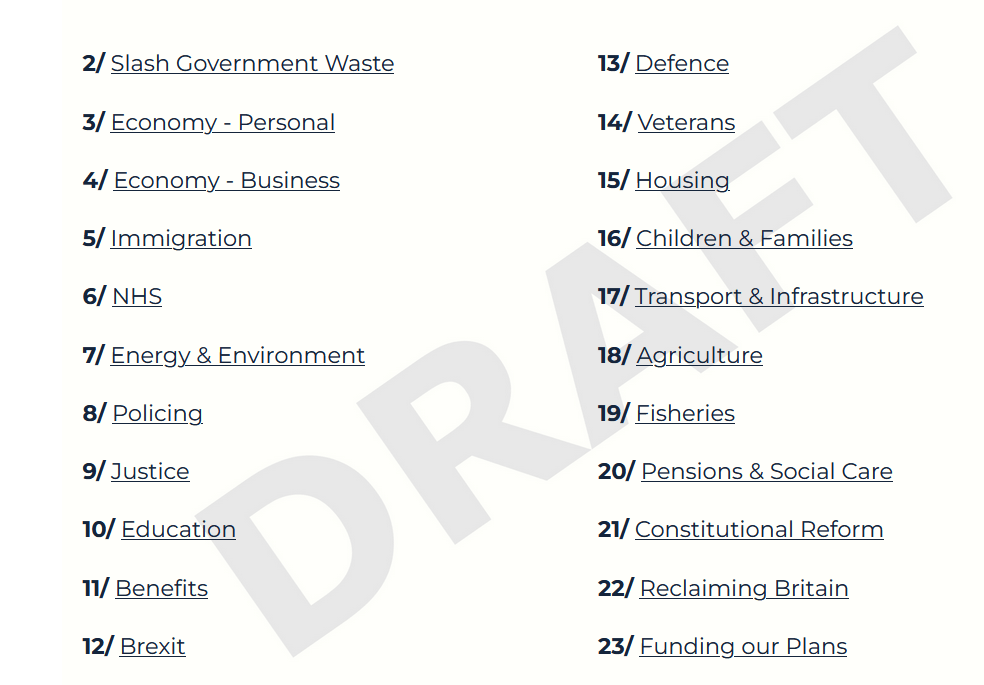
    The short version – and the long one – is that they’ve clubbed together to Brexit Harder. That’s pretty much it, although it’s probably worth noting that they’ve shown the self-restraint to put immigration 4th on their list of priorities, despite it really being the only thing they care about with any earnestness. Equally worth noting is that, for some ineffable reason, this is point 5 on the list, because… well, look:

    Why would you do that? Don’t they know what their first priority is? Did they forget the number 1 exists? Did somebody delete “put the foreigners in labour camps” and forget to reformat the list?

    And while only one of these points is officially Brexit, a quick read shows that they’re all really also More Brexit, but in specific areas of Brexiting Harder. The 21st point (point 22) starts with “Affirm British Sovereignity.” The 18th point (point 19) starts with “Stop EU Fishers Taking UK Quotas”. And so on.

    To be fair to them, they have also made room for flavour-of-the-month culture war topics like gender identity and critical race theory. And there’s a smattering of the typical incongruously sane proposals that always sneaks in to these things. But, in all honesty, the policies themselves aren’t what makes them either interesting or relevant. That’s all in what they’re going to do to marginals.

    Blue-on-Blue

    Much like UKIP before them, they’re a major threat to fringes of the Labour and Tory vote. But putting it like this paints a somewhat misleading picture, so I’m now going to over-explain it.

    Reform have taken a substantial percentage of the Labour vote, spread over the last 18 months or so. However, that damage is already done and the trend stabilised a while ago, then recently started reversing a little. This suggests the vast majority of the Labour vote that would move to Reform have already done so and some are perhaps moving back. Yet, despite this, Labour are still polling well above 40%.

    Which is a problem for the Tories, for (at least) two reasons.

    First, it makes persuadable Tory voters the next obvious target for Reform. It isn’t like they’ll be winning over Lib Dem or Green voters, and they’ve already done what they can to the Labour base. However, there is no shortage of disenchanted Conservative-leaning voters, which means Reform could potentially ruin a few otherwise-winnable seats that the Tories can’t afford to lose. The Tories seem to know this, with a flurry of policy announcements that can only be targeting core Reform votes: bring back National Service and add another lock to pensions.

    Second, those voters went from Labour to Reform and, looking at the polls, they didn’t get there via a brief dalliance with the Conservatives. This means they’re very unlikely to go en masse to the Tories, no matter how hard they try to win them over. The situation this creates is effectively asymmetric osmosis; Reform could leech off some Tory votes, but the Tories will find it very hard to do the same in return.

    Don’t get me wrong – the loss of that much of the vote to Reform is bad for Labour. To suggest otherwise would be pure spin. It means they have a smaller attack surface for their campaign, in terms of making fewer Tory seats truly competitive. But that damage has already been done and Labour are still 15-25 points ahead in the polls, depending who you listen to.

    As those votes are already lost to Reform, Labour need worry less about them being lost to the Conservatives, which would be a far bigger problem for them. An 8% swing towards Reform is simply closing the gap between Labour and Conservative candidates by 8%, whereas the same swing to the Conservatives would be a devastating 16% swing in the votes that really matter.

    Finally, at the end of it all, Reform are very unlikely to win many – or possibly any – seats. 11% of the vote spread out over the entire country doesn’t translate to winning 11% of the seats; it translates to coming 2nd-4th in 100% of the seats. This is what happened to UKIP and, for the record, no matter how much I hate these arbitrarily spiteful crackpots, I consider that to be a major failing of our democracy.

    In summary, Reform UK consists of the part of the electorate who were very disappointed that the 2016 referendum got them what they wanted, because it turns out they really just enjoyed being angry about it. To try and maintain that high, they’re gradually drifting towards a policy of physically lifting the UK out of the ocean and dropping it directly on Brussels, mooning all the way down. They pose a significant risk of costing the Tories a lot, without winning enough themselves to be able to offer any kind of post-election agreement that would return the Bastards In Blue to government.

    2024 Election Preview – Hub

    Toot toot!

    What’s that, children?

    It’s the election bus! And look, it’s being driven by… a tiny sad clown in a sodden Henry Herbert two-piece!

    *assorted honking and the slapping of oversized shoes*

    Yes. It’s election season again. In six weeks, we’ll be able to go and briefly stand in a re-appropriated toilet stall in a local leisure centre to use a pencil we wouldn’t have stolen anyway. Through this mystical rite, we may turn our will into democracy manifest. It is, in a sense, a bit like transubstantiation.

    I’m obviously elated – because I’ve got a politics problem – but this one has come a bit out of the blue and trying to make sense of what’s actually going on is… less clear than it’d usually be at this point. Thankfully, there are people who absolutely aren’t experts but are full of semi-informed opinions who’re on-hand to help with that. And thankfully for you in particular, I am one of those people.

    I’ll be straight with you right from the off: I’m not even going to pretend to be impartial here. Or anywhere else, for that matter. Honest, sure. Informative, if I can be. Entertaining, I hope. But if you’re one of the three lucky weirdos a year who has stumbled across this place for the first time, be warned.

    Here’s links to overviews of who is doing what and who isn’t really doing anything.

    Conservatives

    Labour

    Reform UK

    Liberal Democrats

    Everyone Else

    A Word On Polling

    The polls are pretty consistent, across all sources: Labour are set for a substantial win. But a word of caution.

    First, polls change. Regardless of who you plan to vote for, don’t be complacent or defeatist. The numbers will shift over the coming weeks and the only thing any of us can do is go out and vote. Even if we’re idiots who for some reason want more of the babbling shitebats who’ve been in power for the past 14 years. Please don’t be one of them.

    Second, a lot of polls this year are using what’s called MRP – multi-level regression and post-stratification. It’s a clever system that uses techniques widely applied within Machine Learning systems, attempting to adjust figures for a whole host of demographic and other factors.

    It has a pretty good hit rate, generally performing better than other methods. However, like all of them, it uses certain assumptions. And the problem with assumptions are they can be wrong. The MRP figures are such at the moment that I’d not be surprised if there’s something in there throwing things a bit. It could be good old-fashioned sampling errors, but it could also be some variable within the MRP algorithm itself. Or it could be nothing. But my gut feel is that the variances we’re seeing suggest these models are painting a slightly too-rosy picture for Labour.

    That’s not to say I don’t think they’ll win, and quite handily at that; that’s very much my expectation. All it means is that the confidence with which certain sources are predicting massive 400+ Labour majorities could be a bit ambitious. But, that said, the data we have is all there is to go on, so I’ve done just that throughout.

    (D)UP Sticks & Leave

    Quick straw poll: who else had forgotten the DUP have been keeping the Tories in power? I certainly had. They’ve been so quiet. I’ve heard so little from them since the election, they’d entirely slipped my mind. Until today, when they made it clear they haven’t forgotten.

    Which is particularly suspicious when you consider what a bunch of unreasonable, angry ball-bags they are. Have they been holding out for just this set of circumstances? Maybe. It would be an easy power-multiplier for them, leveraging their position well beyond that which they could otherwise hope for.

    Both major factions within the Tories risk a lot by being too inflexible. In fact, I’d say that their insistence that the EU is bluffing as a negotiating tactic is a projection on the part of the hard-Brexit crowd. Quite aside from the fact I don’t think the EU is bluffing, nothing says “bluffer” more than someone insisting the other person is themselves telling porkies. We tend to convince ourselves the best outcome is the most likely, which when you’ve got a shit hand translates to hoping your opponent is lying about having a good one.

    Besides, refusing to budge is likely to end catastrophically for the Conservatives. Warnings that the party may split seem a bit fanciful. But the idea that the DUP end their confidence & supply agreement, disenfranchised MPs from one or the other wing of the Tory party defect elsewhere, and they lose the subsequent (and inevitable) General Election? More feasible.

    But what do the DUP have to lose from sticking to their guns? Most of the people they’d upset can’t and wouldn’t vote for them anyway. They have a handful of MPs and would come off looking like they’d bargained hard and either A) won or ii) stood by their principles.

    So, there are three possible outcomes for Brexit negotiations: the DUP get what they want; they don’t and we have a General Election; or, they concede demands for much greater leverage in other matters.

    The worst of these for the DUP is the second and, in this eventuality, I think they still come out looking good to their voter base. All cases are a win for them, albeit big/small/moderate, respectively.

    While all of this is hilariously incompetent on the part of Theresa & Co (Theresco?), I think it means we’re now more likely to see a no deal scenario. That’s because the deal now must somehow achieve the following three things:

    1) No land border between Northern Ireland and Ireland. (EU position and legal commitment by the UK government as part of the Good Friday Agreement)

    2) No sea border between Northern Ireland and the rest of the UK. (DUP position)

    3) Control over borders that prevents the free movement of people, goods and capital between the EU and the UK. (UK government position)

    It can’t be done. You can at most manage two of them.

    Any attempt at a land border is doomed; it could at worst revive The Troubles, but in the very least would exact an extremely high diplomatic cost. But the EU’s preferred solution – special status for Northern Ireland – is one of the DUP’s red lines. So it seems unlikely there will be a land border or special status for Northern Ireland.

    If there’s no land border, there must be a sea border. This is another of the DUP’s red lines. This leaves condition three impossible to police in any practical manner. If there is no land border and no sea border, there is just no border.

    The only way to not cross a DUP red line means the Brexiteer Tories will be apoplectic. They may even vote down their own deal, which I can only see leading to a General Election.

    The only hope for the Tories without the DUP is that Labour or the SNP get onboard with whatever deal is tabled. Such a deal would be such a shift from what their own MPs would accept that we are then potentially in No Confidence vote territory. Which very quickly turns into – you guessed it! – a General Election.

    I worry that, faced with these three incompatible criteria, the likelihood is that no choice will be made at all. We will have no deal, which is the worst possible deal. We’ll be even more divided as a society, having proven our inability to reconcile our differences through politics and compromise. Voters on both sides of the argument would lose any last faith that their elected representatives can be effective.

    That is the very definition of a broken democracy and I don’t know where it would lead. My only guess is that it would be nowhere good.

    Or – and this is the tiny glimmer of hope – they do what they usually do when things look difficult, which is palm the problem off to someone else: the electorate. I don’t think this will happen, but the fact it could happen is relief from what otherwise seems to me a very grim outlook indeed.